


Rate Cuts & Red Flags: Why History Suggests Trimming Risk Now
- Ryan Seewald

- Feb 2
- 4 min read
Updated: Feb 25
As we enter February, we continue to take a very cautious approach to portfolio positioning. Reducing risk in portfolios has been a main theme in our overall market view for many months. Given where we are in the current rate cycle, we don’t believe equity markets are properly pricing in the risks of a potential economic downturn.
Historically speaking, market tops prior to deep corrections tend to be made when the Federal Reserve either pauses or starts to lower interest rates. The three largest equity market corrections over the past 30 years came when the Fed was lowering rates.
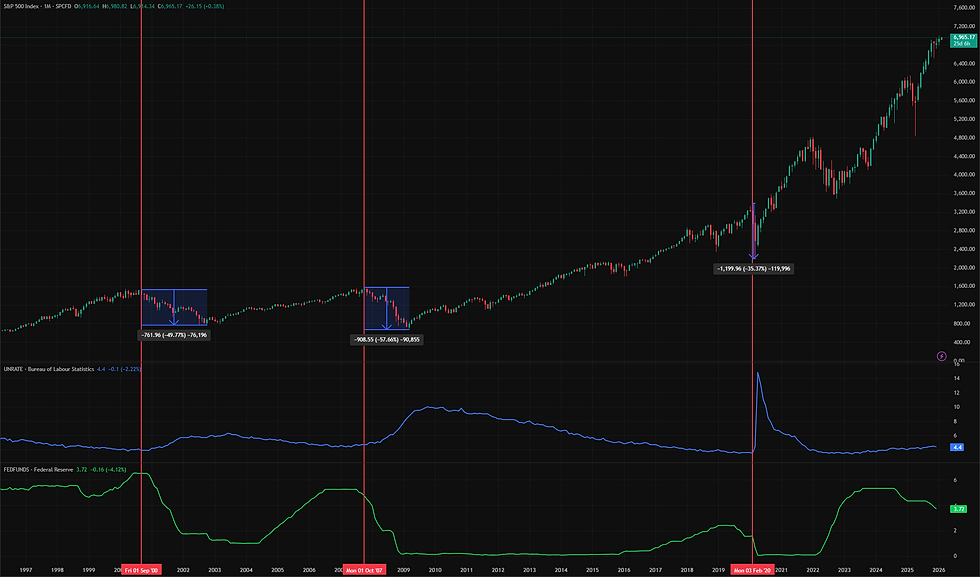
The chart above is broken into three separate sections over the past 30 years. The large pane at the top is the S&P 500, the middle pane (blue line) is the unemployment rate in the US, and the bottom pane (green line) is the federal funds rate. The last three times the Fed started to lower rates over that time period were January of 2001, August of 2007, & August of 2019. A majority of investors remember those three periods vividly: 2001 was the bursting of the “dot com bubble”, 2007-2009 was the global financial crisis, & 2020 was COVID. During those periods, the S&P 500 suffered declines of roughly 50%, 58%, & 35%, respectively, which also correlated with large spikes in unemployment throughout the country.
In our opinion, the reason why the economy & market almost always tends to roll over during these periods is because the Fed is usually almost always too late when it comes to cutting rates and easing financial conditions. That said, we do not envy them as their job is incredibly difficult when it comes to knowing when the right time is to raise or lower rates. “Threading the needle” tends to be near impossible during these times. To better understand why, we need to understand the power of controlling rates and the effect it has on the economy. Rates dictate borrowing costs for everyone, consumers, businesses, etc. Simply put, the higher rates are the more expensive it is to borrow. The lower they are, the cheaper it is. In an effort to maintain a “healthy economy” the Fed will raise interest rates when the economy shows signs of overheating and they are concerned of the potential of a prolonged inflationary period (much like we recently saw post-Covid). They will also then lower rates when they are concerned of the potential of an economic downturn. But why are they almost always late?
The effect that interest rate changes have on the economy takes time. It is not a solution that takes hold overnight. Data shows that on average it takes roughly 18 months for the effects of changes in rates to filter through to the economy. So, the data that the Fed is receiving comes with a significant lag period. Meaning that if the Fed is waiting to see some form of negative data come through (slight rise in unemployment, decrease in economic activity, etc.) prior to lowering rates, there is still roughly 18 months of poor data coming down the pipeline. Because of this, and the fact that almost every Fed Chairman would rather deal with a recession than runaway inflation (like we saw in the 70’s & 80’s), they are almost always too late to lower rates without something breaking and causing a recession.
In actuality, we almost saw this happen already back in the beginning of 2023. Most people forget given 2023 was a great year for equities, but we were on the precipice of what was likely going to be another large financial crisis, with Credit Suisse, Silicon Valley Bank, & others all going under. Luckily for banks and market participants, the Fed stepped in with the BTFP (Bank Term Funding Program), which allowed banks to borrow money against their underwater high-quality assets (mostly government-backed bonds). For example, if a bank had a treasury bond that was worth only 70 cents on the dollar, they were allowed to borrow as if the bond was worth 100% of its par (face) value. In our view, had the Fed let that moment play out without intervening, we would most likely be sitting with rates much lower than where they are today, but we also understand allowing another financial crisis to happen is not the ideal choice.
This all may seem very critical of the Federal Reserve, as their job is nearly impossible to perfect, but we’d be remiss not to point out the obvious correlation that this point in the rate cycle and market downturns have had over the past 30 years.
Most importantly, how should portfolios be allocated right now? In our view, it makes most sense to continue to reduce risk and lower equity exposure across the board, while also taking potential tax liabilities into consideration. We believe that the cash raised from reducing equity exposure would be best parked in either short-term treasuries or money markets. For more opportunistic clients, long-term treasuries also present an attractive risk/reward profile. Of course, we never suggest clients make drastic changes such as lowering equity exposure substantially but taking 10-20% of a portfolio and earning 3.5-4% risk-free while being patient seems like the most prudent thing to do right now. We believe that maintaining some “dry powder” will prove to be beneficial at some point in the future.


