Market commentary
Weekend at Bernie's: CPI, Rates & the Economy
July 18, 2026 · 5 min read
CPI came out this week and has been the main topic of conversation since. All the focus has been around how it affects the outlook on interest rates going forward. Which raises a question worth asking: how good is Wall Street at predicting interest rates?
Every year, the Fed surveys professional forecasters on where rates are headed. Below is every interest rate prediction Wall Street analysts made in regard to where they thought rates would be in 12 months just prior to every major drop in interest rates over the past ten years.
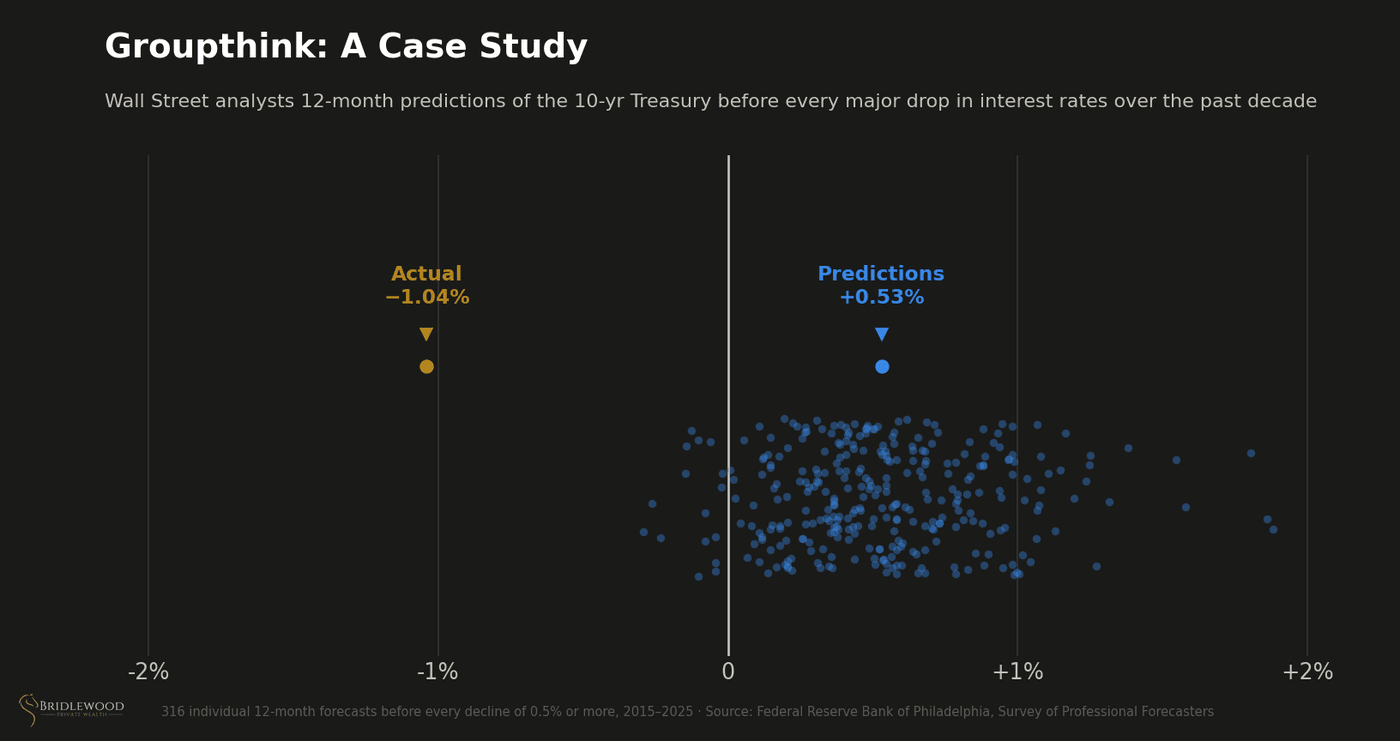
The average prediction had rates increasing by half a percent, when rates actually wound up falling by a full percent. That is a massive gap in the world of interest rates. That said, predicting where rates wind up from an absolute percentage standpoint 12 months from now is near impossible, clearly. In my opinion, if one wanted to project rates, the best way to do it is from a directional standpoint. Literally just, do I think rates will be lower 12 months from now, or higher, and why. That gives you the ability to focus more on the causation of why rates may move in either direction, instead of where they wind up from an actual percentage standpoint.
The main reason why literally every prediction wasn't even close over the past decade is because of two things. First, the data the predictions are based off of is backwards looking, and they assume that all things hold constant moving forward. Second, and by far the larger issue is that firms do not make it easy for analysts to give strong predictions if they go against consensus, even if they have one. From an analyst's standpoint, the risk of having a strong opinion and being wrong far outweighs the incentive of having one and being right. This is the same for any investment that analysts give predictions on, not just rates.
Luckily I'm not an analyst, and get paid directly from the people I'm giving the advice to. A much better incentive system in my opinion, but I digress. The trajectory of interest rates is probably one of the strongest opinions I have. My belief is that there is a higher probability that rates come down from here than there is for rates to continue to grind higher, but as I always say, I have been wrong before and I will be wrong again. The three scenarios below seem to make the most sense to me as potential catalysts for a sizable reversal in interest rates. And I believe they aren't being taken into consideration currently.
Economic weakness
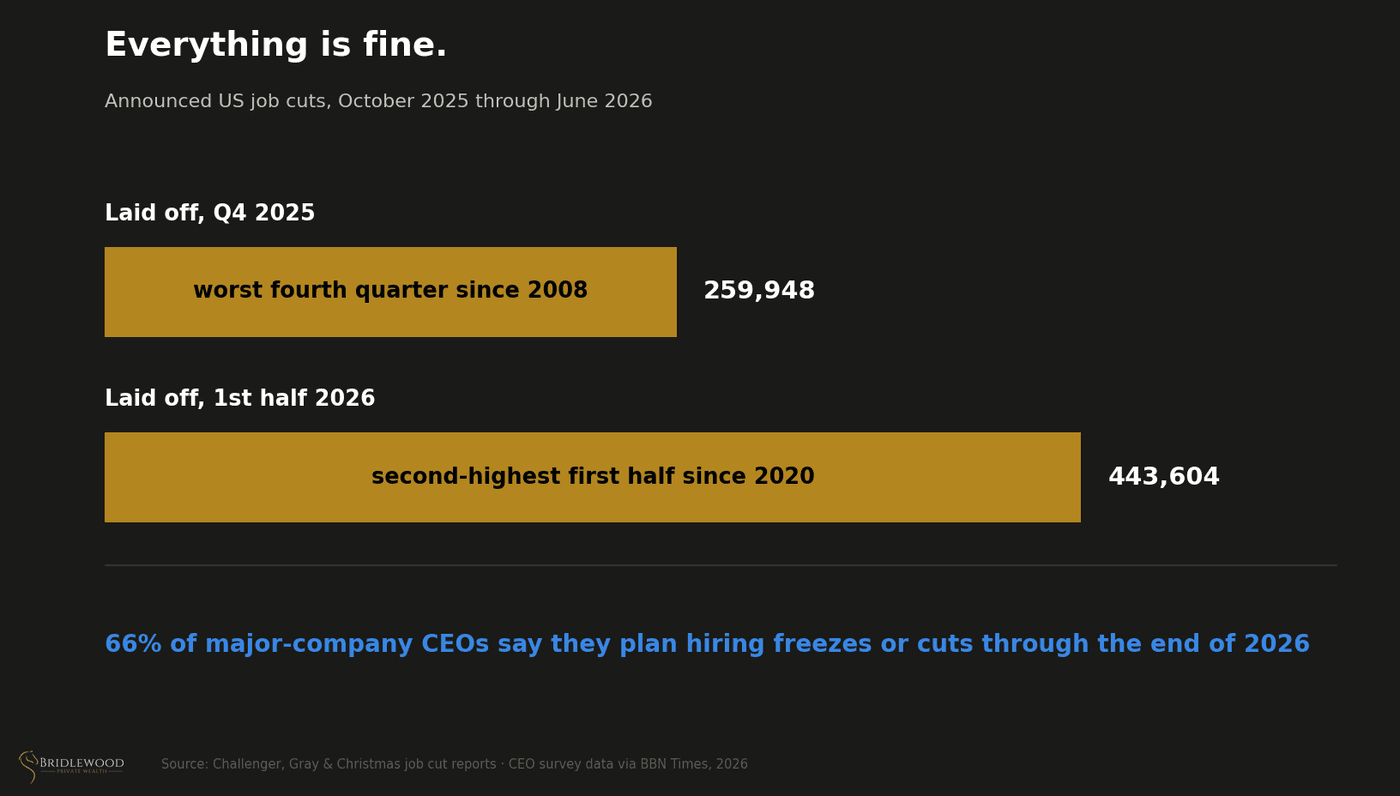
The first road is the simplest one. The economy is nowhere near as strong as the headlines suggest. Over the past nine months alone, US companies have announced over 700,000 job cuts. The fourth quarter of 2025 was the worst fourth quarter for layoffs since 2008, and the first half of this year was the second highest first half since 2020. On the other side of that coin, companies are not replacing the people they let go. Two thirds of major-company CEOs have said they plan hiring freezes or additional cuts through the end of 2026.
Private equity & private credit
Anyone who follows the firm on Instagram (@bridlewoodprivatewealth), or has been patient enough to let me rant knows how I feel about this entire space. For those who don't, I think private credit/equity are by far the biggest risk in financial markets, and have for the past couple years. If you want to know why, visit our Instagram page above or read our insight on the private equity and credit landscape. As of this spring, the SEC, the Treasury, and the Fed are all investigating the space, which should tell you something. How this ties back to lower rates is if that unwind ever gets messy, money will do what it always does in a time of panic like that. It will flow to US Treasuries. That is what's called "a flight to safety", and it drags rates down with it. Certainly the least desirable way, but impossible to ignore.
If I'm wrong
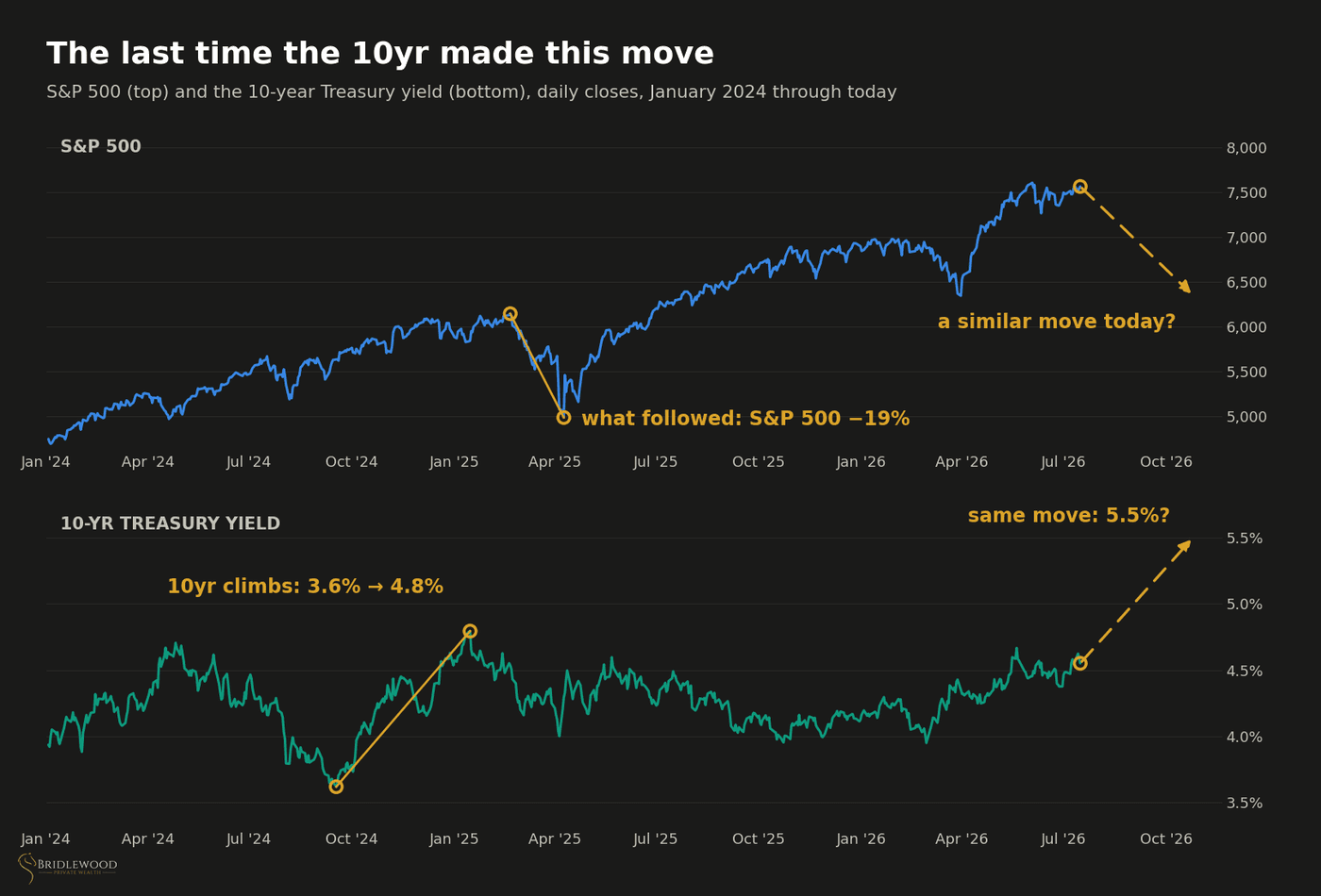
The most comical way I could see it happening is if I'm wrong initially. Obviously rates are still high. High enough that it's causing large budget cuts throughout many industries (i.e. the labor market issue above). But the stock market seems to only care about AI instead of pricing in any room for error. My opinion is that if I'm wrong, it will be short lived. For reference, the chart below shows from September 2024 to January 2025 when the 10yr went from roughly 3.6% to 4.8%, which was followed by the S&P falling nearly 19% from its peak. If the 10yr makes a similar move today, from roughly 4.6% up to say, 5.5%, I believe it could cause a correction even larger than what we saw in 2025. Oddly enough, that could also then drive rates down the same way it would in the private market example, via a "flight to safety" driving rates back down after initially rising.
That said, these are just three scenarios. There are certainly other paths that could potentially drive rates lower. The one that you will/have read about the most is that the Fed is able to thread the needle and land this economy safely - the "soft landing" theory. As much as I'd prefer that, I do not think that will be the path we inevitably see.