
This is the first research piece Bridlewood has written on an individual company, and I believe it is for good reason.
For anyone who has read prior market pieces, it should be no surprise that I believe tokenization will produce some of the best investment opportunities over the next 5+ years. Tokenization is multifaceted and will change the entire infrastructure of global financial markets in many ways. A couple of which we addressed earlier this year in our Stablecoins episode and our Beyond Bitcoin piece, but there are many more.
One of tokenization's biggest challenges has been finding a way to give financial institutions an incentive to adopt it.
Figure Technology Solutions (FIGR) seems to have solved this. It has approached tokenization and blockchain as a whole from a much more practical direction: help institutions conduct business in the same way they are used to but make it faster, more efficient, and cheaper without trying to cannibalize their business.
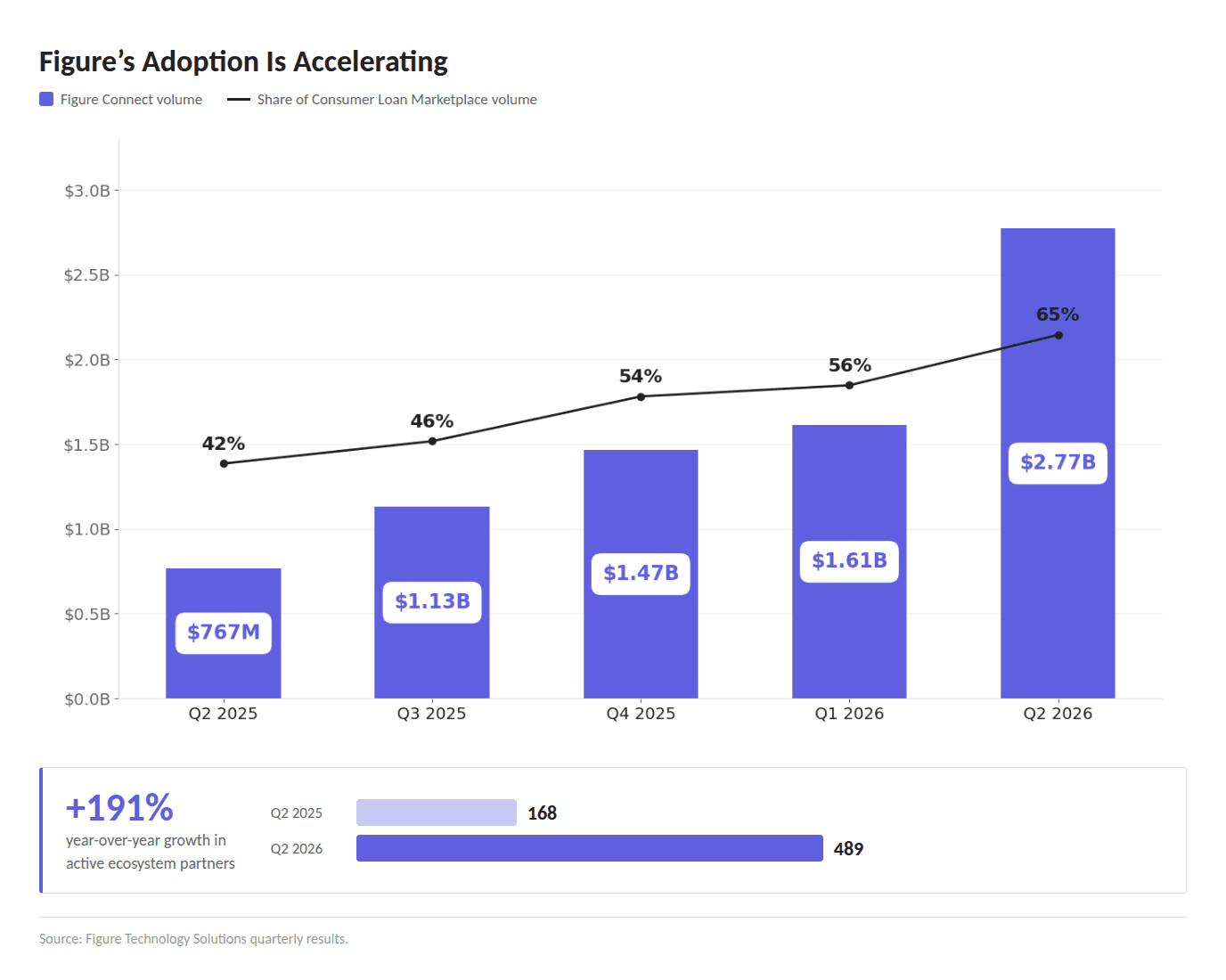
The primary areas that Figure focuses on currently are securitization (think securities that are packed with mortgages, HELOCs, auto loans, etc), as well as private credit markets. That said, securitization has become one of the clearest demonstrations of the platform's adoption, which has exploded as of recent.
Securitization is a process of lenders combining loans, such as mortgages, into a pool and creating securities backed by borrowers' payments. Large institutional investors like pensions, endowments, insurance companies, etc. buy those securities and collect the income generated from them. Before the securities reach buyers, the loans must be underwritten, documents reviewed, ownership verified and the investment structured. Lenders, legal teams, review firms, rating agencies and other intermediaries each handle part of that process, adding time and cost.
Amongst other things, Figure has built its business around improving that process.
The company uses blockchain and AI to standardize the data and documentation required to sell and securitize loans. Instead of information repeatedly passing between separate systems and intermediaries, the process is completed through a common "one stop shop" platform connecting lenders and investors. This helps accelerate the process, allowing lenders to recover their capital faster while reducing costs for both sides.
The problems do not end once the security is created though. Investors are buying a pool that can contain thousands of individual mortgages, making the quality and performance of those underlying loans critical to their due diligence. That information is often collected by different servicers, processed by data providers and delivered through separate databases or static reports. This makes it difficult and expensive for investors to consistently evaluate the actual loans they own and monitor changes as they occur. We all learned this the hard way during the 2007-2008 financial crisis (if you don't know, watch "The Big Short").

Figure replaces much of this fragmented reporting by standardizing loan-level data and making it available to investors in real time through blockchain. Instead of relying on separate databases and static reports, investors can evaluate the underlying loans through a shared, verifiable record. Recording ownership and transfers on the blockchain also prevents the same loan from being pledged to multiple parties. Something that caused major losses of roughly $2.5-$3.5B throughout multiple banks due to the blow-ups of two companies late last year, First Brands & Tricolor.
The vision behind Figure becomes clearer when looking at co-founder and executive chairman Mike Cagney. Before starting Figure, Cagney co-founded and led SoFi, giving him firsthand experience with how loans are originated, financed and sold. In explaining why he founded Figure, Cagney pointed to the unnecessary complexity within financial transactions, noting that "you have a buyer and seller, but also seven or eight other parties that sit in between that transaction." He recognized that blockchain could remove much of that intermediation by allowing both sides to transact using the same verifiable record.
Cagney and his team's strategy on how to position their platform to institutions was ingenious. Instead of having the company solely focus on selling the platform to new institutions initially, they started out as a lender themselves. Making HELOC loans to homeowners, using their platform to securitize the loans they made, and either holding the loans on their balance sheet as investments (being the lender and the buyer) or finding buyers willing to use the platform. Essentially taking on the risk of lending their own capital to borrowers in order to show the efficacy of its platform, with the end goal of eventually getting away from being a "traditional lender" and instead becoming the "rails" on which the securitization market runs.
That strategy has seemingly been executed to perfection thus far.
More than $2.4 trillion of securities were issued across the U.S. securitization market in 2025, while Figure facilitated only $3.8 billion through its blockchain-based infrastructure. That volume reached roughly $3.5 billion in the first half of 2026 alone, putting Figure on pace for approximately $7 billion this year, nearly double its 2025 total. Even at that pace, Figure would account for less than 0.3% of the broader market. As one of the only companies focused on rebuilding this infrastructure through blockchain, Figure has established a significant head start. The size of the opportunity is difficult to overstate.
They are also applying their infrastructure to private credit, a market whose lack of efficiency, transparency and liquidity I have criticized repeatedly. Figure directly addresses all three and could completely reshape how the entire private credit market operates.
Finding a potential "home run" investment that is still in its infancy is incredibly difficult and most often comes with much more risk the shorter your time horizon is as price swings can be large at times. In my view, finding an industry still in its infancy that has the potential for exponential growth, then finding a company that is currently the best within that small space, gives you much more room for error. At that point, the primary question becomes whether the industry will be widely adopted. I believe Figure fits that profile today.
That said, many other companies are doing great work within tokenization, creating investment opportunities across both equities and digital assets. Bridlewood is hyper-focused on this emerging sector and has been building dedicated allocations within portfolios. If you're interested in learning how tokenization could fit into your portfolio, complete the form linked below.
As of publication, the author and certain clients of Bridlewood Private Wealth own shares of Figure Technology Solutions (FIGR), creating a financial interest in its share price. Holdings may change. This commentary is not personalized investment advice. Investing involves risk, including loss of principal, and future results are not guaranteed.